
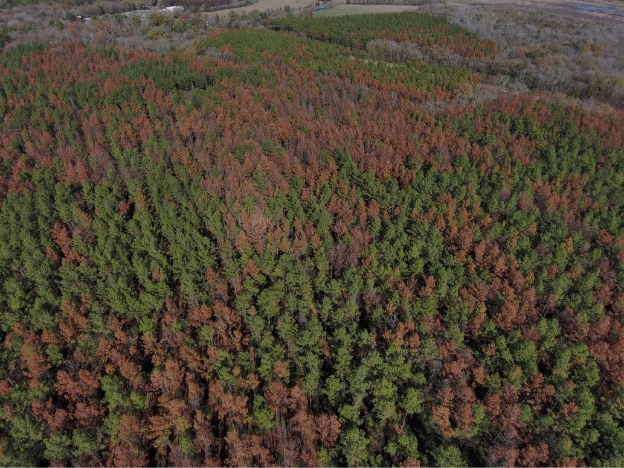
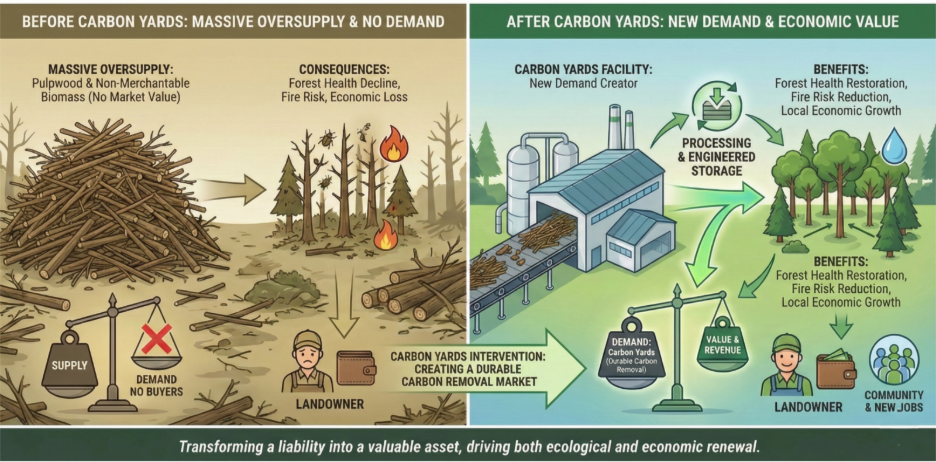
Over the past fifteen years, demand for pulpwood across the U.S. Southeast has declined sharply, fundamentally reshaping the economics of forest management. Pulpwood, small-diameter harvested trees traditionally used in paper manufacturing, once provided the revenue needed to finance early and intermediate plantation treatments. By removing suppressed or overcrowded trees and selling them as pulpwood, landowners could cover the costs of creating the growing space required for higher-value sawtimber to develop. As markets deteriorated, however, this long-standing system stopped functioning. Pulpwood prices fell below harvesting costs, eliminating the economic incentive to thin overcrowded stands. Millions of acres of pine plantations have since become increasingly dense, physiologically stressed, and vulnerable to pests, drought, and wildfire. Confronted with declining stand health and limited financial options, landowners often must sell distressed timber at a loss or clear-cut and burn material prior to reestablishing stands, an expensive and disruptive option. In this environment, conventional management practices no longer offer a viable pathway to sustain forest health or long-term productivity.
A New Model for Durable Engineered Carbon Removal
Carbon Yards responds to this structural challenge by creating an economically viable and permanent end-use pathway for biomass that no longer has a market. Developed by EP Carbon, it introduces a new Terrestrial Biomass Storage approach to be implemented across the U.S. Southeast, with the first facility to be constructed in Georgia. The project sources biomass from certified forest operations within a 90-mile radius—an area that encompasses more than 15 million acres of sustainably managed forestland—and future facilities are designed to operate with supply sheds of comparable scale
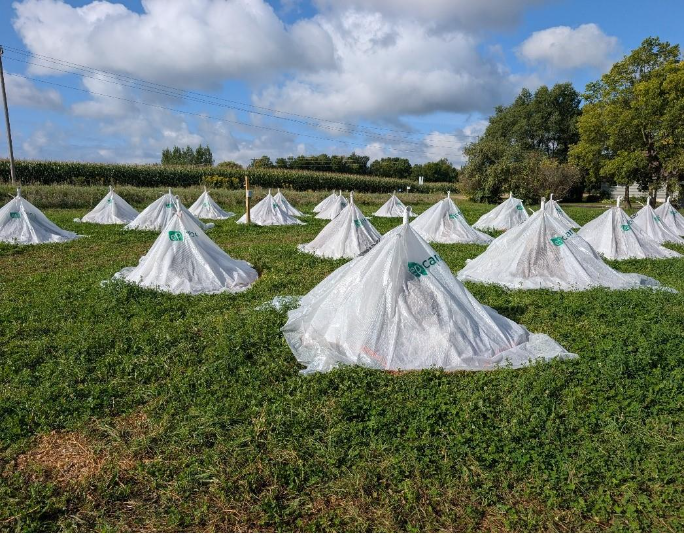
The initiative uses engineered aboveground storage chambers that preserve low-value forest residues and pulpwood by maintaining controlled environmental conditions that prevent decomposition and eliminate the risk of fire-related emissions. Biomass is processed into woodchips, treated with natural halite preservatives, and arranged into covered stockpiles that maintain low humidity, limit microbial activity, and secure carbon for centuries. Each facility will be independently validated under the Puro.earth Standard and uses the Puro.earth’s Terrestrial Biomass Storage methodology, to issue Carbon Removal Certificates (CORCs) for the stored carbon.
Ensuring Additional, Transparent and Permanent Carbon Removals
Carbon Yards delivers high integrity climate outcomes by achieving strong additionality and durable, verifiable carbon storage. This initiative provides immediate additionality by capturing and storing carbon that would otherwise be released to the atmosphere under business-as-usual conditions, while also enabling sustainable forest management practices that enhance forest growth and long-term sequestration on certified forestlands that otherwise would not occur.
Permanence is ensured through a controlled storage environment engineered to maintain low moisture and low oxygen conditions that prevent biological decay and secure carbon for centuries. Once stored, all performance data, feedstock sourcing records, environmental safeguards, and verification evidence are consolidated within the Impact Inside transparency platform, which serves as the centralized system for monitoring, reporting, and stakeholder engagement. Engineered storage chambers are continuously tracked for key preservation parameters, and the platform provides transparent, auditable evidence of carbon stability, supply shed compliance, and adherence to environmental and social safeguards.
By combining these elements, Carbon Yards creates a complete and verifiable carbon removal outcome that unites avoided emissions, enhanced forest sequestration, and durable storage, resolving the long-standing challenge of coupling additionality with permanence in nature-based solutions.
Unlocking Landscape Regeneration at Scale
By restoring a viable market for low-value biomass, Carbon Yards unlocks the ability to implement forest restoration treatments at scale. These treatments open forest canopies, giving stands renewed access to sunlight, water, and nutrients that were previously limited by overcrowding. This improved ecological space allows native species to regenerate naturally across much larger areas, improving habitat structure, increasing food availability, and supporting greater biodiversity. The resulting gains in forest vigor also strengthen watershed health, as deeper ground cover and more robust root systems reduce erosion, stabilize soils, and contribute to cleaner waterways. Further by removing the excess branches, small trees, and woody debris that typically build up in unmanaged forests, Carbon Yards also reduces the amount of fuel available to burn. This lowers the risk and severity of wildfires, helps protect long-term carbon stocks, and safeguards sensitive habitats throughout the sourcing area.
Driving Rural Economic Renewal
Carbon Yards revitalizes rural economies by creating a stable market for low-value biomass and by attracting new investment to forest-dependent communities. The project supports employment in construction, biomass logistics, transportation, facility operations, and environmental monitoring, and it directs procurement toward regional suppliers and service providers. It also contributes to workforce development through training programs in forest management and ecological monitoring. Because operations extend across a ninety-mile supply shed, these economic benefits are distributed throughout a broad multi-county region. For landowners, the model restores the financial rationale for long-term stewardship, enabling sustainable forest management in an environment where depressed pulpwood markets have made thinning economically unviable. Rather than postponing essential treatments or absorbing financial losses, landowners gain a practical and reliable path to improve forest health while generating new revenue.
Scalability Across U.S. and Global Forest Regions
While the first facility is being implemented in Georgia, the Carbon Yards model is designed for replication across a wide range of forest regions in the United States and internationally. Overstocked stands, low-value biomass, and non-merchantable material are not challenges unique to the Southeast; they occur in many forested landscapes, including the western United States as well as regions in Latin America, Europe, Africa, and Asia. Because the approach is modular, cost-effective, and tied to supply-shed economics rather than constrained by specific forest types or geographies, it can be deployed wherever comparable conditions and feedstock dynamics exist. This positions Carbon Yards as a nature-based solution with unique scalable potential, capable of delivering consistent ecological and socioeconomic benefits across diverse forest landscapes worldwide.
A New Standard for High-Integrity, Nature-Based Carbon Removal
Carbon Yards represents a paradigm shift in how nature-based carbon removal can be delivered at scale. By combining engineered durability with the restorative power of sustainable forest management, the project creates a transparent, measurable, and long-lived carbon asset that buyers can confidently support. For organizations seeking high-integrity carbon removals that generate lasting environmental and socioeconomic value, Carbon Yards offers a compelling pathway that strengthens forest health, revitalizes rural livelihoods, and secures durable carbon storage aligned with global climate goals.

Cyril Melikov, M.F. Director Forest Restoration Initiatives
Cyril leads EP Carbon’s forestry restoration initiatives, specializing in both qualitative and quantitative assessment of nature-based carbon projects. His work directly supports clients in VCS methodology selection and ensuring conformance with VCS standard. With expertise spanning inferential statistics, carbon accounting, agronomy, and silviculture, Cyril specializes in designing voluntary carbon projects across diverse ecological contexts. His recent projects have focused on improved forest management and afforestation, reforestation, and revegetation initiatives including agroforestry systems, plantations, and diverse native species mixes. Cyril holds a Master of Forestry from the University of California, Berkeley, where his research examined how forest management practices such as fertilization and thinning impact plantation carbon stocks.