
Across the Southeastern United States, forests are not struggling because of a lack of productivity. They are struggling because the markets that once made managing them viable have largely disappeared.
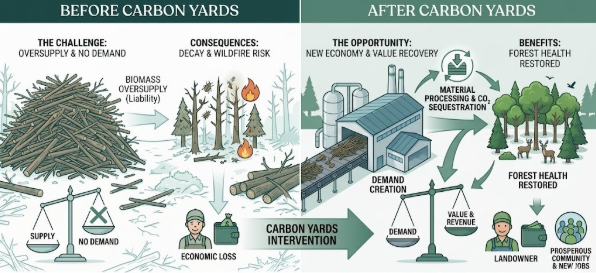
Over the past decade, demand for low-value biomass, including pulpwood, forest residues, and small-diameter material, has declined significantly while supply has remained abundant. Market prices for this material have fallen to levels that no longer justify the cost of forest management operations Without a financially viable outlet for this material, the economic logic of active forest stewardship breaks down.
The consequences are visible across the landscape. Overcrowded stands compete for light, water, and nutrients. Woody material accumulates on the forest floor, elevating fuel loads and wildfire risk. Landowners defer necessary interventions or absorb losses to maintain basic stewardship. Over time, forest health declines, and with it, the economic foundations of the rural communities that depend on working forests.
Restoring the Market That Makes Management Possible
Carbon Yards was designed to address this structural challenge at its source.
By creating a durable and predictable market for low-value biomass, Carbon Yards restores the financial viability of restoration-aligned forest management. Materials that would otherwise be left to decay or burn are instead securely stored for the long term, preventing the rapid carbon re-emissions that come with decomposition or wildfire.
This market signal reactivates the underlying economic engine of forest management. Thinning and fuel reduction treatments become financially viable again. Landowners and operators can implement the interventions that improve both forest condition and long-term productivity, not as an act of charity, but as a sound economic decision.
From Distressed to Thriving Forest Ecosystems
By making thinning and fuel reduction economically viable, Carbon Yards unlocks a cascade of ecological recovery that deferred management had put on hold.
As Carbon Yards enables restoration treatments to scale across the landscape, stand density decreases and forests begin to breathe again. Sunlight, water, and nutrients become available to the trees and plants that remain, creating the conditions for natural regeneration of native species. Understory vegetation reestablishes. Forest systems transition toward more diverse and structurally complex states. This matters because poor forest structure, the direct result of years of deferred management, leaves stands increasingly vulnerable to pest and disease outbreaks, more frequent and severe droughts, and a range of natural disturbances that healthier, more balanced forests are far better equipped to withstand.
Carbon Yards does not just remove material from the forest; it changes what the forest becomes. These structural improvements support increased habitat complexity and improved ecological function, enhancing biodiversity and contributing to the long-term stability of forest ecosystems across the supply shed.
The benefits extend below ground as well. By enabling the recovery of vegetation and root systems, Carbon Yards helps soils stabilize and retain water more effectively. Ground cover returns, reducing erosion and limiting sediment transport into nearby waterways, with measurable improvements in water quality and watershed function at the landscape scale.
Reducing Wildfire Risk and Protecting the Carbon Within It
For carbon buyers, the risk profile of a forest matters as much as its current stock.
Carbon Yards directly addresses one of the most significant threats to long-term carbon integrity: wildfire. By creating a market for the excess woody material that accumulates in unmanaged stands, Carbon Yards enables the removal of surface fuel loads that would otherwise make fires harder to control and far more destructive.
This protection is consequential for carbon buyers. High-severity fire events generate large pulse emissions that can rapidly reverse decades of carbon accumulation in standing forests, in soils, and in the credits connected to them. By enabling active fuel management at scale, Carbon Yards makes the carbon it delivers meaningfully more durable.
Economic Renewal Across Rural Communities
Carbon Yards also generates meaningful economic benefits across the rural communities that surround these forests.
Each facility supports employment across construction, biomass logistics, transportation, operations, and environmental monitoring. Because sourcing extends across a broad supply shed, these benefits are distributed across multiple counties rather than concentrated in a single location.
For landowners, the model restores the financial rationale for active forest stewardship. In regions where thinning has become economically unviable, Carbon Yards provides a pathway to improve forest health while generating new revenue, reducing the need to defer management and supporting more consistent, long-term engagement in sustainable forestry.
How Carbon Yards Tracks What It Promises
These outcomes are supported by a structured monitoring framework. Social and environmental indicators are managed through the Impact Inside platform, which consolidates field data and tracks performance over time, covering local employment, supplier engagement, forest regeneration, soil stability, and wildfire risk.
By embedding monitoring directly into project operations, Carbon Yards ensures that both benefits and risks are transparently managed and continuously evaluated.
Carbon Removal That Realigns Incentives
Carbon Yards is designed not only to deliver durable carbon removal, but to realign market incentives with ecological outcomes.
By restoring demand for undervalued biomass, it enables a transition from deferred management and gradual degradation toward active regeneration at scale. Healthier forests, more resilient ecosystems, and stronger rural economies are not secondary outcomes; they are integral to how carbon removal is delivered.