
As interest in carbon dioxide removal grows, buyers are increasingly focused on what constitutes high-quality, credible carbon outcomes. Too often, climate claims stem from activities that mix long-term promises with short-term effects, creating uncertainty around whether carbon is truly removed or simply shifted on paper. The Reconstruction of Carbon Outcomes offers a compelling reframing: carbon outcomes are more credible when the functions of removal and storage are separated and intentionally designed. Carbon Yards embodies this approach for biomass carbon removal and storage, offering a pathway grounded in sound carbon science and robust project design.
Why Carbon Outcome Architecture Matters
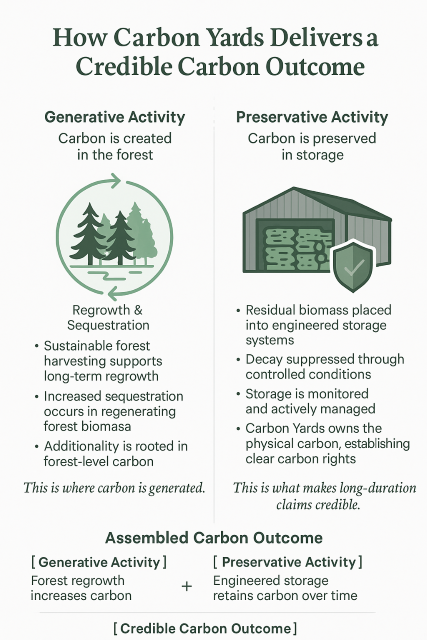
The framework distinguishes between a generative activity, which alters carbon flows relative to a credible baseline, and a preservative activity, which ensures that removed carbon remains sequestered over long periods. When these functions are conflated, it becomes difficult to demonstrate true additionality or durable storage. By structuring Carbon Yards around distinct generative and preservative components, the project delivers a carbon outcome that is both measurable in the near term and designed for long-term durability, aligning with evolving expectations for high-quality carbon removal.
Delivering Additionality Through a Generative Activity
In the Reconstruction framework, additionality arises from a generative activity that produces a real, observable change in carbon flows compared to what would have occurred without the project. The emphasis is on immediate, measurable impact rather than hypothetical future states.
In the Carbon Yards system, this generative activity occurs in the forest. Sustainable forest harvesting supports ongoing regrowth, and regenerating stands sequester additional carbon over time relative to baseline management. By creating a durable outlet for residual material with limited economic value, Carbon Yards supports management regimes that maintain working forests, reduce disturbance risk, and promote regrowth. The additional carbon benefit arises from incremental sequestration in forest biomass over time, not from the handling of the harvested material itself. This framing aligns with emerging expectations that biomass-based removal must demonstrate real, landscape-level carbon gains grounded in observed practices.
Ensuring Durability Through a Preservative Activity
Durability—or permanence—is a cornerstone of credible carbon outcomes, and the framework treats it as the result of a separate preservative activity, not an assumed attribute of removal. Durable storage requires engineered systems that are actively managed and monitored over time.
Carbon Yards meets this requirement by placing biomass into engineered, above-ground storage systems designed to suppress decay and control oxygen and moisture exposure. Storage is monitored and maintained as an ongoing operational function. Importantly, Carbon Yards owns the physical carbon it stores, establishing clear and undisputed carbon rights throughout the storage period. Together, engineered durability and legal clarity reduce long-term risk and support confidence in permanent carbon storage.
What This Means for Carbon Buyers
By separating generative and preservative activities, Carbon Yards avoids the structural challenges that have limited many traditional biomass or nature-based credits. Additionality is delivered through quantifiable, long-term forest regrowth, while durability is supported by engineered storage and clear carbon rights. Each function can be evaluated independently, strengthening transparency, auditability, and confidence.
The Reconstruction of Carbon Outcomes makes the case that credible carbon markets will be built through better design, not stronger claims. Carbon Yards demonstrates how that framework can be applied in practice—offering a biomass carbon removal pathway that delivers real climate impact today and durable carbon storage over time.

Cyril Melikov, M.F. Director Forest Restoration Initiatives
Cyril leads EP Carbon’s forestry restoration initiatives, specializing in both qualitative and quantitative assessment of nature-based carbon projects. His work directly supports clients in VCS methodology selection and ensuring conformance with VCS standard. With expertise spanning inferential statistics, carbon accounting, agronomy, and silviculture, Cyril specializes in designing voluntary carbon projects across diverse ecological contexts. His recent projects have focused on improved forest management and afforestation, reforestation, and revegetation initiatives including agroforestry systems, plantations, and diverse native species mixes. Cyril holds a Master of Forestry from the University of California, Berkeley, where his research examined how forest management practices such as fertilization and thinning impact plantation carbon stocks. .