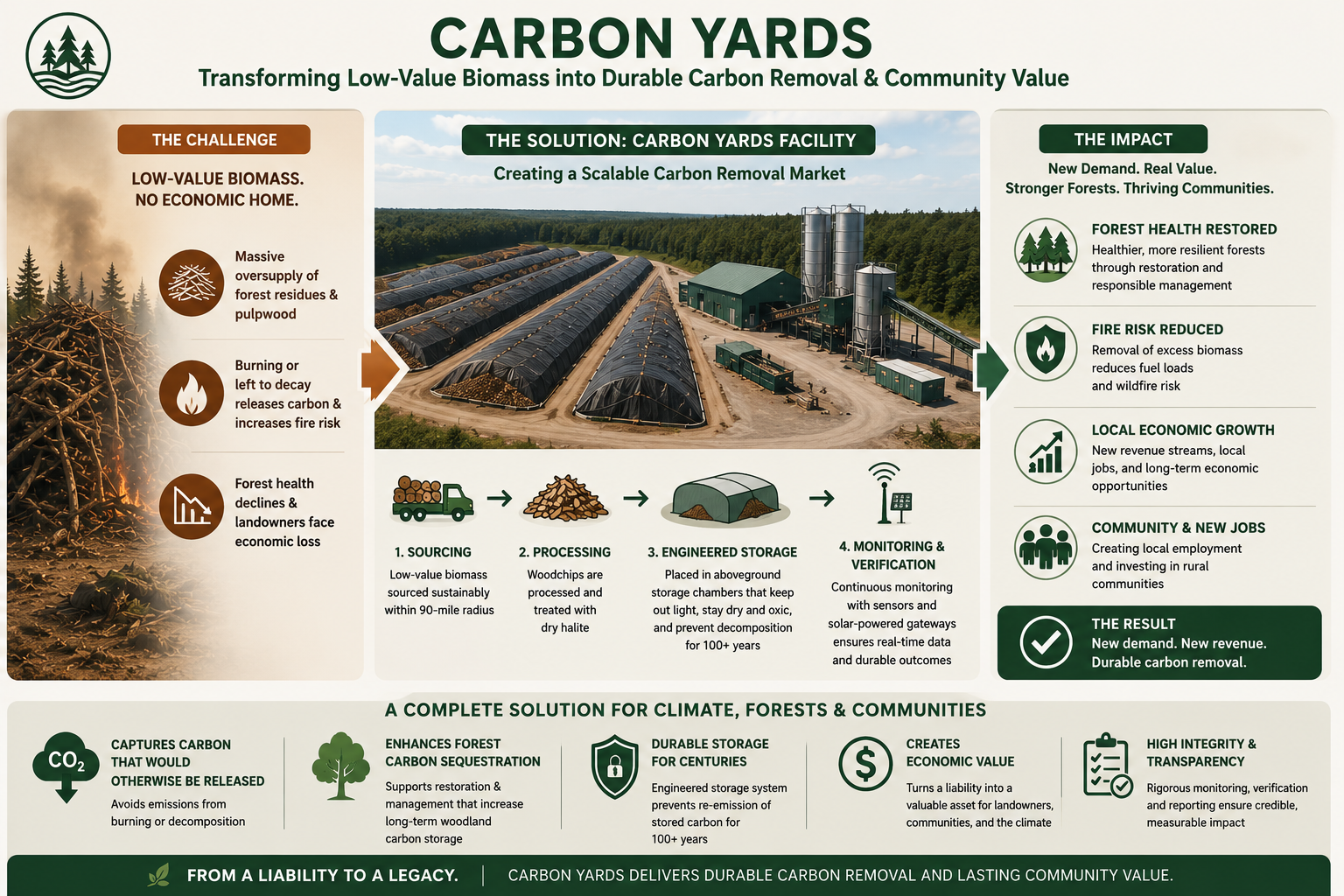
We are proud to announce that Carbon Yards HCO2 Mississippi has successfully completed the Puro.earth Preliminary Assessment process and has been granted Future Facility status on the Puro.earth Supplier Listing.
The project can be found on the Puro.earth Suppliers Registry .
This milestone marks a significant step forward for one of the most innovative and scalable terrestrial biomass storage projects currently in development in the United States.
What is Carbon Yards?
Carbon Yards HCO2 provides a scalable pathway for converting low-grade forest residues and pulpwood, materials that would otherwise be burned or left to decay, into a durable form of carbon removal. By unlocking the economics of forest restoration and management at scale, the project generates highly durable and additional carbon removal credits at a very low cost.
Located on a former gravel pit in Mississippi, certified woodchips are sourced from forestry operations within a 90-mile radius encompassing more than 16 million acres of forest land, treated with dry halite on-site, and placed into carefully engineered aboveground storage chambers that keep out light, maintain dry oxic conditions, and prevent decomposition for more than 100 years. Each chamber is continuously monitored with sensors and solar-powered gateways, ensuring real-time data collection and verification.
Carbon Yards addresses one of the fundamental challenges in carbon removal: combining strong additionality with long-term permanence. The model delivers immediate additionality by capturing and durably storing carbon from low-value woody biomass that would otherwise be burned or left to decompose under business-as-usual conditions. At the same time, by creating a long-term market for low-grade fiber, it improves the economics of sustainable forest management, enabling restoration treatments that enhance forest productivity, resilience, and long-term carbon sequestration on certified working forests. The engineered storage system prevents the re-emission of stored carbon for centuries, creating a complete, measurable, and verifiable carbon removal pathway that integrates avoided emissions, enhanced forest sequestration, and durable carbon storage.
In addition to delivering durable carbon removal through a highly additional and permanent storage pathway, the project generates meaningful environmental and socioeconomic co-benefits:
- Rural employment and vocational training opportunities.
- Sustainable forest management and ecosystem regeneration.
- Wildfire risk reduction.
- Improved watershed health.
These outcomes contribute to SDG 6 (Clean Water and Sanitation), SDG 8 (Decent Work and Economic Growth), SDG 13 (Climate Action), SDG 15 (Life on Land), and SDG 16 (Peace, Justice and Strong Institutions).
Initially deployed in Mississippi with plans to expand across the U.S. Southeast, the model has the potential to be replicated wherever forest restoration treatments are needed and low-value biomass or pulpwood are oversupplied. As a U.S.-based initiative, the project also offers buyers additional procurement certainty by avoiding Article 6-related delivery risk.
What the Puro.earth Preliminary Assessment Means
The Puro.earth Preliminary Assessment is a rigorous, independent review of a project’s compliance with the Terrestrial Storage of Biomass (TSB) methodology and the Puro Standard General Rules. It evaluates the facility’s core eligibility, technical design, additionality, monitoring framework, and environmental and social safeguards.
Achieving Future Facility status confirms that Puro.earth has found no major concerns regarding the eligibility of the project and that Carbon Yards HCO2 Mississippi is expected to move rapidly toward full facility certification. The assessment specifically recognized:
- Strong financial and regulatory additionality.
- A high-standard MRV system design.
- Robust permanence and reversal risk management.
- A thorough and comprehensive monitoring plan.
- A conservative and robust carbon removal quantification methodology.
- A comprehensive and robust stakeholder engagement plan.
- A robust life cycle assessment (LCA) approach for estimating project emissions.
- Clearly defined environmental and socioeconomic co-benefits, supported by a high-quality MRV framework to monitor and demonstrate their delivery.
Key Milestones Achieved to Date
Since initiating the Carbon Yards HCO2 development process, EP Carbon has achieved several major project milestones, including:
- Securing the proposed project site through an executed Memorandum of Understanding covering approximately 140 acres of previously disturbed land in Mississippi.
- Successfully completing the Puro.earth Preliminary Assessment and obtaining Future Facility status.
- Developing a comprehensive project design, monitoring framework, MRV system, stakeholder engagement plan, carbon quantification methodology, and life cycle assessment.
- Launching an in-situ field experiment to validate and optimize the selected halite treatment protocol.
What Comes Next
With Preliminary Assessment eligibility secured, the Carbon Yards team is now focused on advancing the project toward full facility validation, targeted for 2027. Key activities over the coming months include:
- Finalizing long-term land agreements.
- Securing all required permits and regulatory approvals.
- Constructing the Carbon Yards facility at the identified project site in Mississippi.
- Completing the ongoing field experiment to finalize the operational halite treatment protocol.
- Continuing stakeholder and community engagement.
- Refining the project’s technical documentation package in preparation for the facility audit.
Why Carbon Yards Matters
The U.S. Southeast holds some of the most productive and underutilized forest landscapes in the world. Changing timber market conditions and the persistent oversupply of low-grade fiber have left millions of tons of biomass without a viable economic destination, contributing to declining forest health, elevated wildfire risk, and unnecessary carbon emissions. Carbon Yards changes that calculus.
By creating a transparent, traceable, and permanent home for this biomass, the project delivers durable carbon removal while simultaneously strengthening the economics of responsible forest stewardship at regional scale. We believe Carbon Yards represents a replicable model for high-integrity, low-cost carbon removal that is deeply rooted in the ecological and economic realities of working forest landscapes.
We look forward to sharing further updates as the project advances toward its first facility audit and, ultimately, its first CORC issuance.