
Carbon Yards is an engineered carbon storage system designed to preserve forest biomass under controlled above ground conditions. The system combines treatment, engineered storage, and continuous monitoring into an integrated operational framework designed for century scale carbon storage.
At its core, Carbon Yards functions as a tightly coordinated physical and digital system. Biomass is treated, placed into purpose-built storage structures, and continuously monitored to maintain controlled internal conditions and manage known risks over time. Together, these elements form a repeatable approach to delivering durable carbon storage at scale.
Sustainable and Fully Traceable Biomass Sourcing
All biomass is sourced exclusively from certified forest operations, including FSC, SFI, and similar standards, within an approximately 90-mile supply shed encompassing more than 15 million acres of sustainably managed forestland. Chain of custody documentation is required to ensure full traceability from forest to facility.
Upon arrival at the facility, material is transported by truck, weighed on certified scales, and logged into a tracking system that links each delivery to verified sourcing and volume data. Together, these measures establish traceability from forest to storage and provide the foundation for accurate carbon accounting.
Engineered Biomass Treatment and Storage System for Carbon Permanence
Once onsite, woodchips are treated using a halite-based salt application prior to storage. Treatment is carried out via a mobile assembly trailer unit that enables controlled mixing and uniform application of the treatment to incoming biomass.
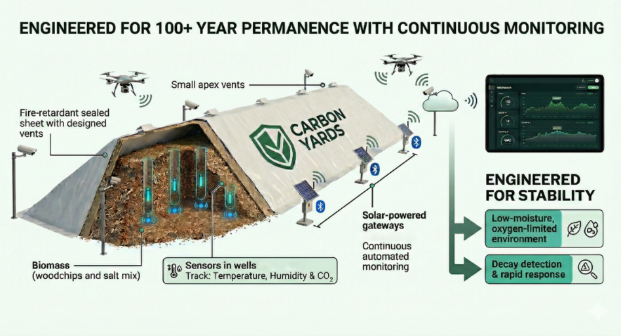
Treated biomass is then placed into engineered above ground storage units designed specifically to manage the risks associated with long term biomass storage. Stockpiles consist of either one or three chambers, depending on site layout and capacity requirements. Each chamber within a stockpile is sealed using reflective fire-retardant polyethylene sheets that limit oxygen ingress and protect against external ignition risks.
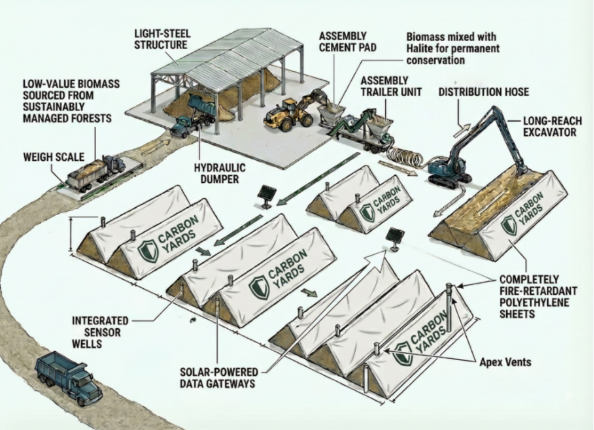
Apex vents and perforated chimneys for passive airflow are installed along each chamber to manage internal pressure while maintaining controlled storage conditions. Insulated sensor wells are embedded directly through the fire-retardant sheets at regular intervals and are used for continuous monitoring of temperature, humidity, and CO₂ concentrations within the biomass.
Solar powered data gateways are placed between stockpiles across the entire storage facility, enabling automated data collection and transmission to a centralized monitoring platform.
By keeping storage above ground, Carbon Yards enables direct access for inspection, monitoring, and intervention if needed.
Continuous Monitoring Embedded Into the Storage System
Monitoring is embedded directly into the Carbon Yards storage architecture and is integral to facility operations. Each stockpile is instrumented with sensor wells that continuously measure key preservation parameters, including temperature, humidity, and CO₂ concentrations, with readings captured through a dedicated operational monitoring dashboard that provides ongoing visibility into internal storage conditions across the facility.
Carbon Yards facilities leverage the Impact Inside transparency platform as the system of record for monitoring, reporting, and verification. The platform consolidates monitoring indicators, operational records, and inspection outputs, enabling operators to track storage performance over time and identify deviations from expected conditions.
This monitoring framework supports both day-to-day operational oversight and the long-term documentation required to demonstrate storage durability, traceability, and compliance with applicable carbon removal standards.
Designed and Managed for Long-Term Non-Permanence Risk.
Carbon Yards is engineered for storage durations exceeding one hundred years, requiring a fundamentally different approach to risk management than short-term biomass handling. Non-permanence risks, including biological decay, fire, and environmental exposure, are addressed through a layered system that integrates preservative treatment, engineered physical controls, environmental protection measures, and continuous monitoring.
Biological decay risk is mitigated through mineral-based preservative treatment and storage conditions that limit moisture and oxygen availability, constraining microbial activity. Fire risk is addressed through a combination of fire-retardant covers, controlled stockpile geometry, physical separation between storage units, and site-level fire prevention infrastructure. Other environmental exposure risks are reduced through engineered containment that shields stockpiles from precipitation, surface runoff, and wind, helping maintain stable internal conditions over time.
Monitoring data are used operationally to manage these risks. Abnormal trends in temperature, humidity, or CO₂ concentrations trigger on-the-ground inspections, and where decomposition is detected, corrective actions, including re-treatment of affected stockpiles, are implemented to restore preservation conditions and prevent carbon losses.
Together, this combination of treatment, engineered design, environmental safeguards, and data-driven oversight enables Carbon Yards to deliver measurable and verifiable long-term storage performance.
From Short-Lived Biomass to Long-Term Climate Infrastructure
Carbon Yards transforms a carbon pool that would otherwise cycle back into the atmosphere within years into a form of durable climate infrastructure. By integrating sustainable sourcing, treatment, engineered storage, and continuous monitoring, the system creates conditions under which biomass carbon can remain stored for generations.
The result is a modular and repeatable approach to carbon dioxide removal that can be deployed in regions with abundant low value biomass while maintaining high standards for permanence, transparency, and risk management.
Carbon Yards is not just about storing carbon. It is about designing systems that can be trusted to keep carbon stored while enabling the sequestration of new carbon through continued forest regrowth.

Cyril Melikov, M.F. Director Forest Restoration Initiatives
Cyril leads EP Carbon’s forestry restoration initiatives, specializing in both qualitative and quantitative assessment of nature-based carbon projects. His work directly supports clients in VCS methodology selection and ensuring conformance with VCS standard. With expertise spanning inferential statistics, carbon accounting, agronomy, and silviculture, Cyril specializes in designing voluntary carbon projects across diverse ecological contexts. His recent projects have focused on improved forest management and afforestation, reforestation, and revegetation initiatives including agroforestry systems, plantations, and diverse native species mixes. Cyril holds a Master of Forestry from the University of California, Berkeley, where his research examined how forest management practices such as fertilization and thinning impact plantation carbon stocks.