
The voluntary carbon market is evolving fast. Alongside nature-based solutions, buyers are increasingly adding high-durability, high-integrity engineered CDR to their portfolios, and for good reason. Engineered removals offer the permanence, additionality, and verifiability that the most demanding net-zero frameworks require. But there is a cost problem that no one has solved yet. Until now.
The Price of Integrity, Additionality, and Durability
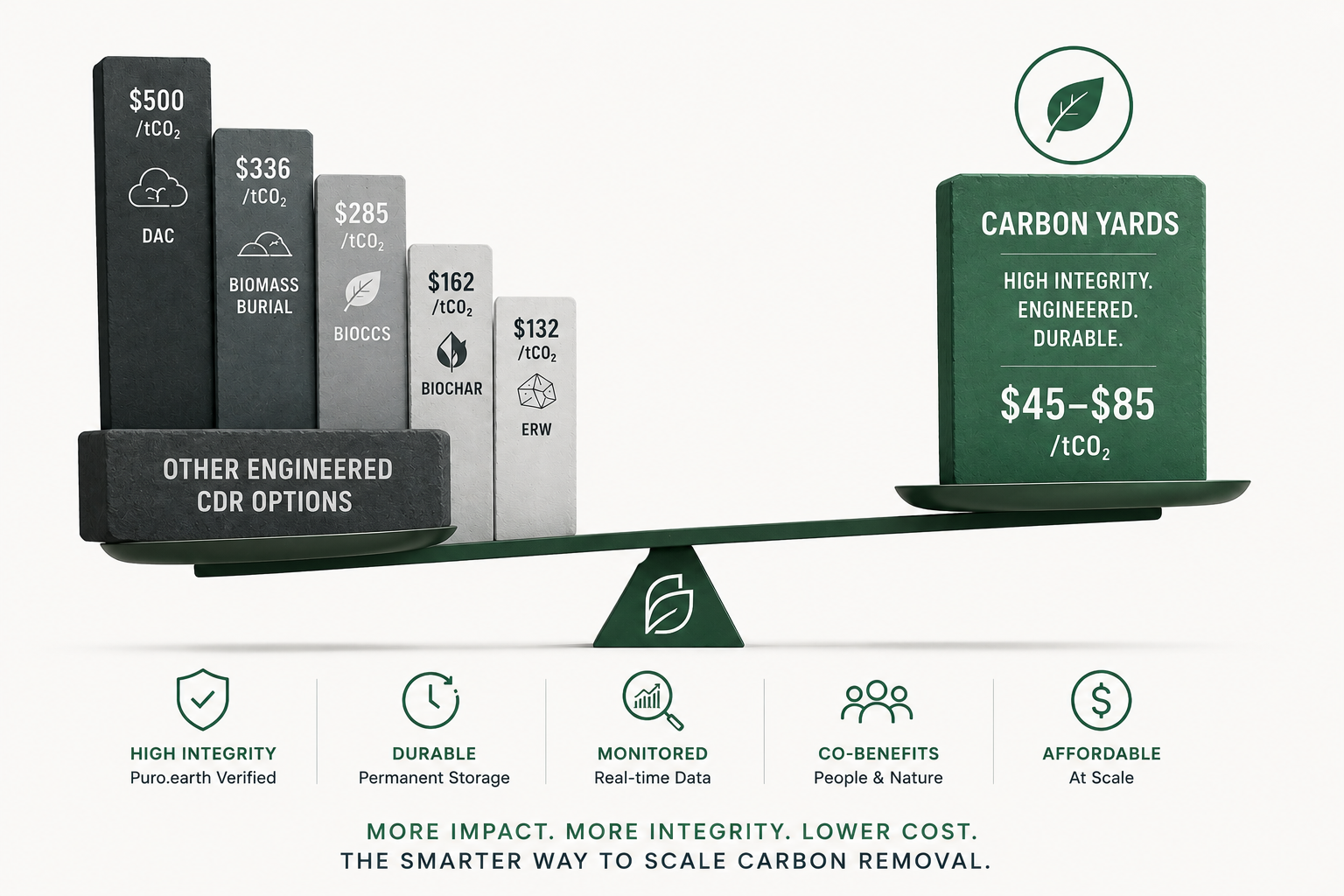
Engineered CDR is not cheap. Direct Air Capture (DAC) trades at approximately $500 per tonne. Terrestrial biomass burial and oil storage credits sit around $336. Bioenergy with Carbon Capture and Storage (BECCS) is approximately $285. Biochar ranges around $162. Enhanced Rock Weathering (ERW) trades around $132. These are real prices for real removals, and for buyers who need to retire tens of thousands or hundreds of thousands of tonnes, they add up fast.
The result is a market where integrity is effectively rationed by price. Companies that want to do the right thing are forced to choose between buying fewer high-quality credits than their commitments require, or supplementing with lower-quality offsets that undermine the credibility of their net-zero claims. Neither is a good outcome.
High Integrity at a Fraction of the Price
Carbon Yards HCO2 delivers engineered, durable, monitored, and Puro.earth-verified carbon removal at $65 to $85 per tonne for U.S.-based facilities, and as low as $45 per tonne for facilities to be established in developing economies. That is not a nature-based offset price. That is not an unverified avoidance credit. That is a permanent, sensor-monitored, registry-listed engineered removal at a fraction of the cost of every comparable pathway.
Importantly, Carbon Yards has successfully completed the Puro.earth Preliminary Assessment and has been granted Future Facility status on the Puro.earth Supplier Listing. Puro.earth found no major concerns regarding the eligibility of the project, specifically recognizing the high standard of the MRV system design, the robustness of the LCA approach, and the thoroughness of the monitoring plan. This is not a self-assessment. It is an independent confirmation by one of the world’s leading engineered CDR standards that the project design looks sound, the additionality is real, and the permanence framework is credible.
To put it in perspective: for the price of one DAC tonne, a buyer can retire six to ten Carbon Yards tonnes. For the price of one biochar tonne, they can retire two. And Carbon Yards credits meet the same Puro Standard that governs biochar and other engineered pathways, covering the same additionality requirements, the same LCA methodology, and the same third-party verification process.
How Carbon Yards Changes the Portfolio Equation
This is where the opportunity becomes strategic rather than merely transactional. Buyers and intermediaries assembling CDR portfolios, whether for corporate net-zero commitments, compliance pathways, or resale to end buyers, face a blended cost challenge. A portfolio that is heavily weighted toward DAC or BioCCS will price out most corporate buyers. A portfolio that is weighted toward low-cost, low-integrity credits will fail scrutiny.
Carbon Yards offers a third path: a high-integrity anchor credit that dramatically lowers blended portfolio cost without compromising quality. A portfolio that combines a meaningful allocation of Carbon Yards credits with higher-cost pathways can deliver the permanence and verifiability the market demands at a price point that actually scales. This is not a compromise. It is a portfolio construction insight.
Consider a simplified example. A buyer assembling a 10,000 tonne portfolio split equally between DAC ($500/t) and Carbon Yards ($75/t) achieves a blended cost of approximately $287 per tonne, roughly equivalent to BioCCS, while delivering a diversified, multi-pathway removal mix with strong permanence credentials across the board. Shift the allocation further toward Carbon Yards and the blended cost drops further still, with no sacrifice in registry-level integrity.
Low Cost, Not Low Quality
The low price of Carbon Yards credits is not a quality signal. It is a structural one. Carbon Yards works because the U.S. Southeast has an abundant, chronically oversupplied feedstock that has no viable alternative market. Non-merchantable logging residues and surplus pulpwood would otherwise decay or burn, releasing their carbon for free, with no credit, no monitoring, and no permanence. Carbon Yards intercepts this material and stores it permanently in engineered aboveground chambers monitored in real time by dense sensor networks. The low cost reflects the economics of the feedstock, not a compromise on the carbon.
Let’s Talk
Whether you are a buyer building a CDR portfolio and looking for a high-integrity credit that works at scale, or an intermediary seeking a differentiated engineered removal product to offer your clients, we want to hear from you.
Carbon Yards is not a discount product. It is a structural solution to the price problem that has been holding the engineered CDR market back, while guaranteeing high-integrity, durable carbon removal credits that generate meaningful social and environmental co-benefits in the communities and landscapes where the facility is established.
Reach out to Cyril Melikov at cyril@epcarbon.com to learn more about Carbon Yards credits, offtake opportunities, and partnership arrangements.