
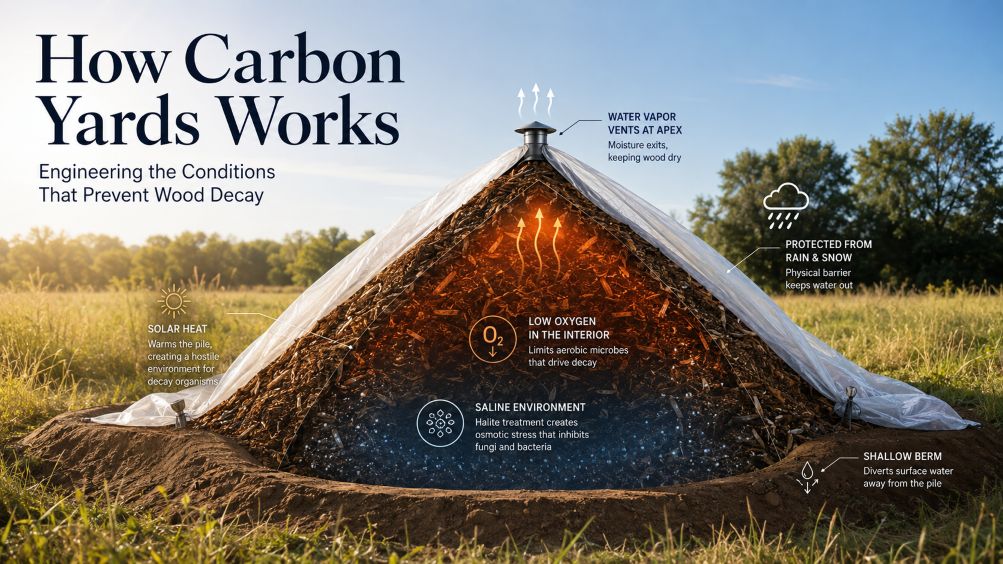
Carbon Yards combines preservation principles that humans have relied on for thousands of years—salt, moisture control, heat, and environmental isolation—with engineered biomass storage and continuous monitoring.
Wood decay is not mysterious. It is biology.
Fungi and bacteria consume woody biomass when the surrounding environment gives them what they need: accessible water, tolerable temperatures, suitable chemistry, and enough oxygen to sustain biological activity. Remove or constrain those conditions, and decomposition slows dramatically.
That basic principle predates modern engineering by thousands of years. Humans have long preserved food with salt and dehydration. Mummification combined desiccation, salts, and physical isolation to preserve organic material for millennia. Carbon Yards applies the same fundamental biological logic to a different problem: how to keep the carbon contained in woody biomass from rapidly returning to the atmosphere.
The innovation is not any single preservation mechanism. It is the deliberate combination of several of them inside an engineered storage system.
Creating an Environment Where Decay Struggles
A Carbon Yard begins with woody biomass that would otherwise have a relatively short atmospheric carbon-storage life—for example, low-value woodchips that could decompose or be burned.
The biomass is treated with halite and placed into engineered, covered stockpiles. The pile geometry, protective sheeting, salt treatment, drainage, and venting work together to create a storage environment that is increasingly hostile to decomposition.
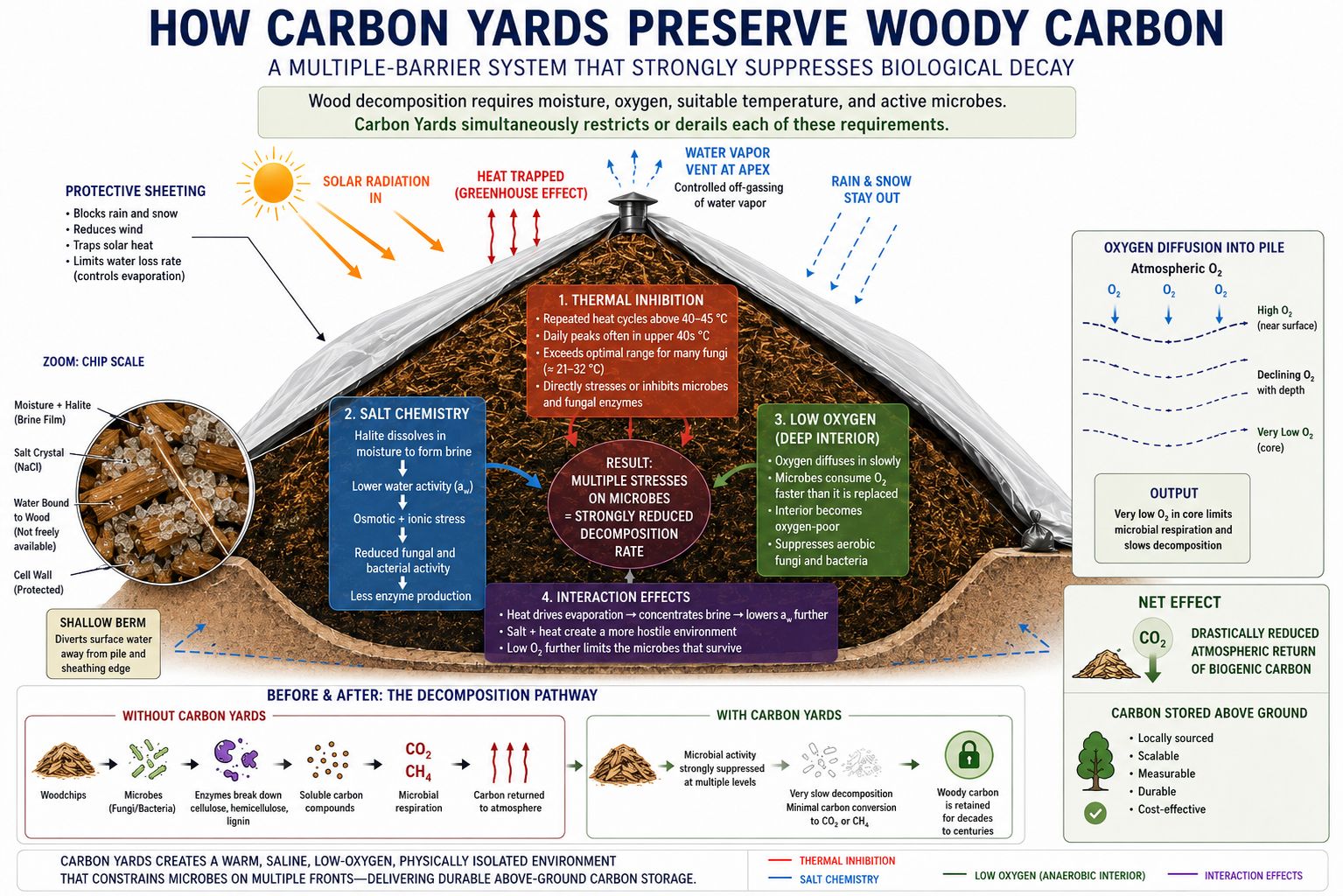
Several preservation mechanisms operate simultaneously.
Salt chemistry. Halite dissolves into the moisture already present in the wood, creating a concentrated saline environment. The resulting brine lowers water activity: water can still physically be present while becoming less biologically available to microorganisms. High salt concentrations also impose osmotic and ionic stress on fungal and bacterial cells, reducing their ability to grow and produce the extracellular enzymes needed to break down cellulose, hemicellulose, and lignin.
Low oxygen. Oxygen can enter the pile from the outside, but diffusion becomes increasingly constrained with depth while microorganisms consume the oxygen that is available. The deep interior therefore develops much lower oxygen conditions, placing another constraint on organisms responsible for aerobic wood decay.
Thermal stress. The protective covering captures solar energy and produces repeated heating cycles within the chambers. Experimental measurements show portions of the piles repeatedly reaching approximately 40–45°C and above, with peaks into the upper 40s. Those temperatures move beyond the preferred growth range of many wood-decay organisms and add recurring thermal stress to an already saline environment.
Moisture control. The protective sheeting limits rain and snow intrusion, helping prevent external water from diluting the salt treatment. A vent at the pile apex allows controlled water-vapor off-gassing, while a shallow perimeter berm diverts surface water away from the chamber.
These mechanisms reinforce one another. Heating can promote moisture movement and concentrate brine. Concentrated brine further reduces water activity. Salt and heat weaken microbial activity, while low oxygen places an additional metabolic constraint on whatever organisms remain.
The result is not a single “kill mechanism.” It is a multiple-barrier preservation system.
We Designed the Experiment to Make Failure Happen Faster
A durability technology should not be evaluated simply by waiting and hoping that nothing happens.
Our field experiment was therefore deliberately designed to make decomposition easier to observe. We added a decomposition accelerant to increase biological activity so that differences between treated and untreated biomass could emerge on an experimental timescale rather than requiring decades of observation.
The experiment uses a Randomized Complete Block Design (RCBD) and has now operated across two field seasons.
For the analysis shown below, we compare one untreated control with three Carbon Yards treatments—T1, T3, and T4—representing increasing halite concentrations. Each group contains five replicated chambers, for 20 chambers in total.
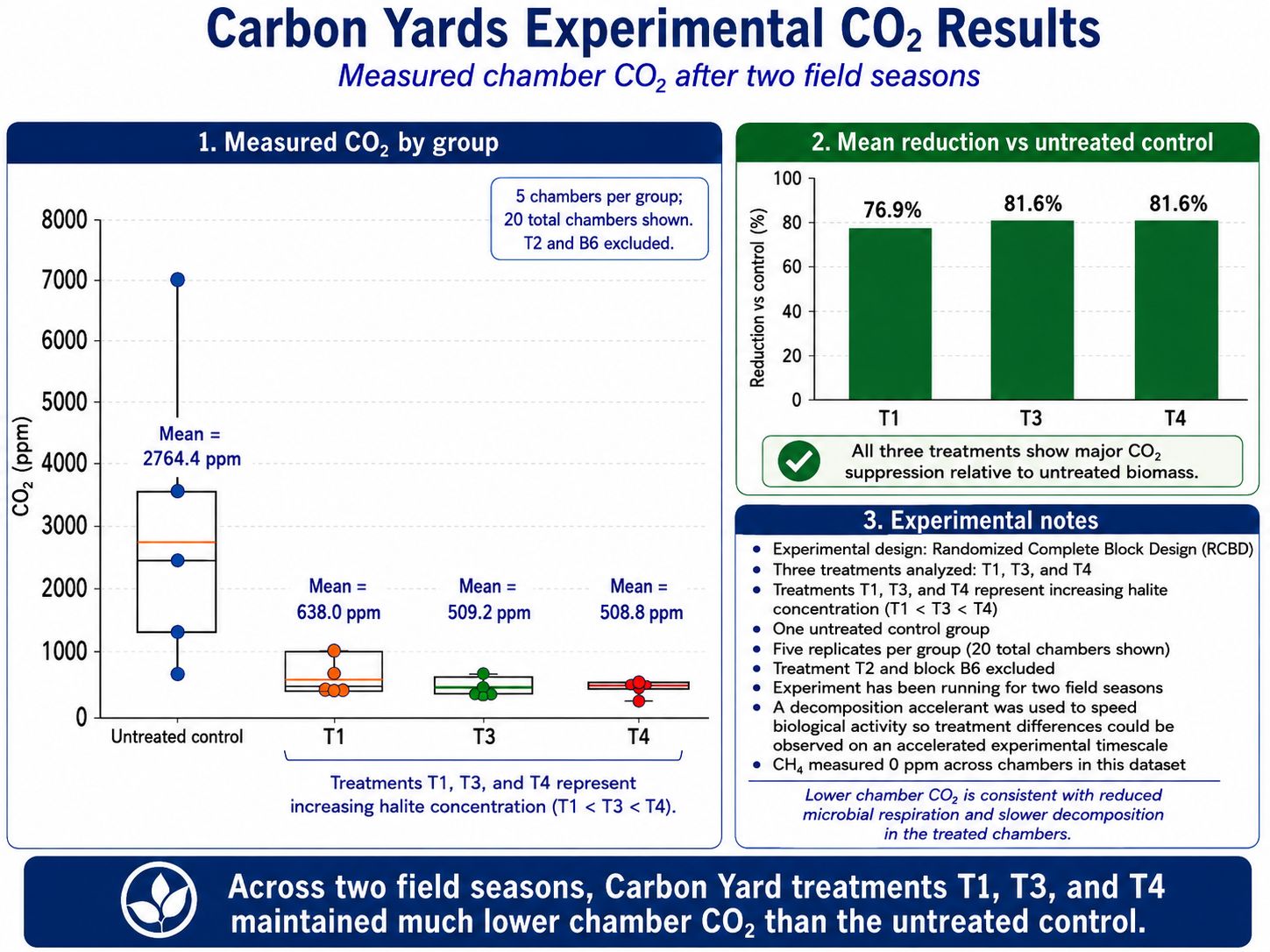
The difference is substantial.
Mean chamber CO2 concentration in the untreated controls was approximately 2,764 ppm. By comparison:
- T1 averaged 638 ppm, a 76.9% reduction relative to the untreated control.
- T3 averaged 509 ppm, an 81.6% reduction.
- T4 averaged 509 ppm, also an 81.6% reduction.
CO2 is important because microbial decomposition of biomass produces carbon dioxide through respiration. The consistently much lower chamber CO2 observed in the treated biomass is therefore consistent with substantially reduced biological decomposition.
Methane measured 0 ppm across the chambers in this dataset, providing no indication that suppression of aerobic decomposition was simply being replaced by measurable methane production under the conditions tested.
The experiment is ongoing. Two field seasons do not by themselves establish a 100-year storage lifetime. They do, however, provide direct field evidence that the preservation environment is having the intended biological effect—and doing so even in an experiment intentionally designed to accelerate decay.
And Then There Is What You Can See
Instrumentation matters. Statistical analysis matters. But sometimes the physical result is also remarkably easy to understand.
The photograph below shows two chambers after two field seasons. The treatment chamber is on the left. The untreated control is on the right.
They started at approximately the same size.
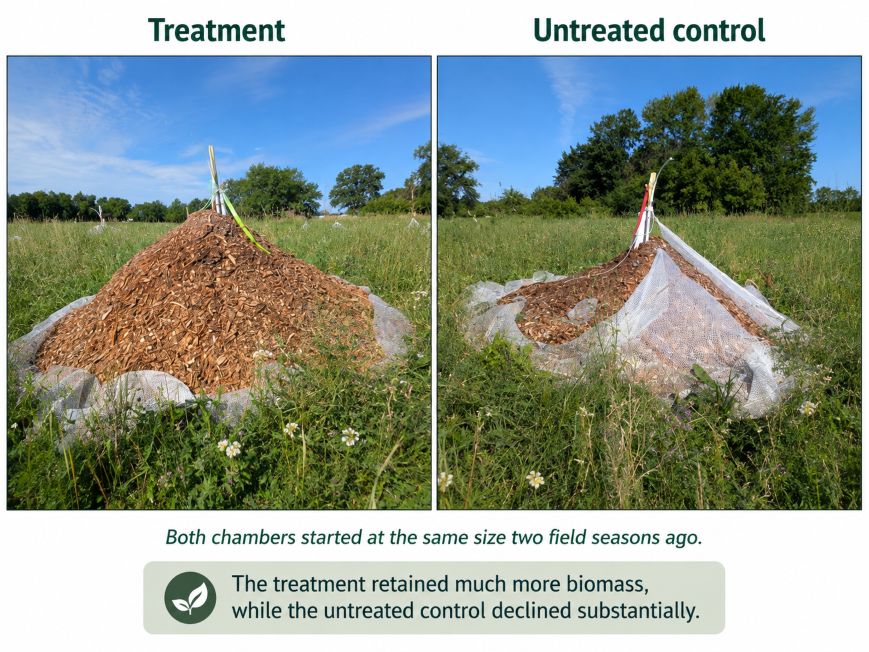
The treated chamber has retained substantially more of its original biomass volume. The untreated control has visibly collapsed as material has been lost and decomposed.
That photograph is not a substitute for quantitative measurement. But it is an unusually intuitive complement to the sensor data: the difference detected in CO2 measurements is also visible in the physical persistence of the biomass itself.
Old Preservation Science, Applied to a New Carbon Problem
There is something deliberately simple about the underlying idea.
Salt preserves food because microorganisms struggle in highly saline environments. Drying preserves organic material because organisms require biologically available water. Mummification worked by combining chemistry, dehydration, and environmental isolation. Humanity discovered these principles long before we understood osmotic pressure, fungal enzymes, or microbial respiration.
Carbon Yards takes those well-established preservation principles and turns them into an engineered carbon-storage system.
The technology does not depend on making wood indestructible. It instead changes the environment around the biomass so that the biological processes responsible for returning that carbon to the atmosphere operate far more slowly.
And importantly, that hypothesis is testable.
We can measure temperature. We can measure oxygen. We can measure CO2 and methane. We can inspect biomass condition. We can compare treated chambers against untreated controls. And over time, those measurements allow preservation performance to be monitored directly rather than inferred.
That is the basic idea behind Carbon Yards:
Store woody carbon in an environment where the organisms that normally consume it have a very difficult time doing their job.