
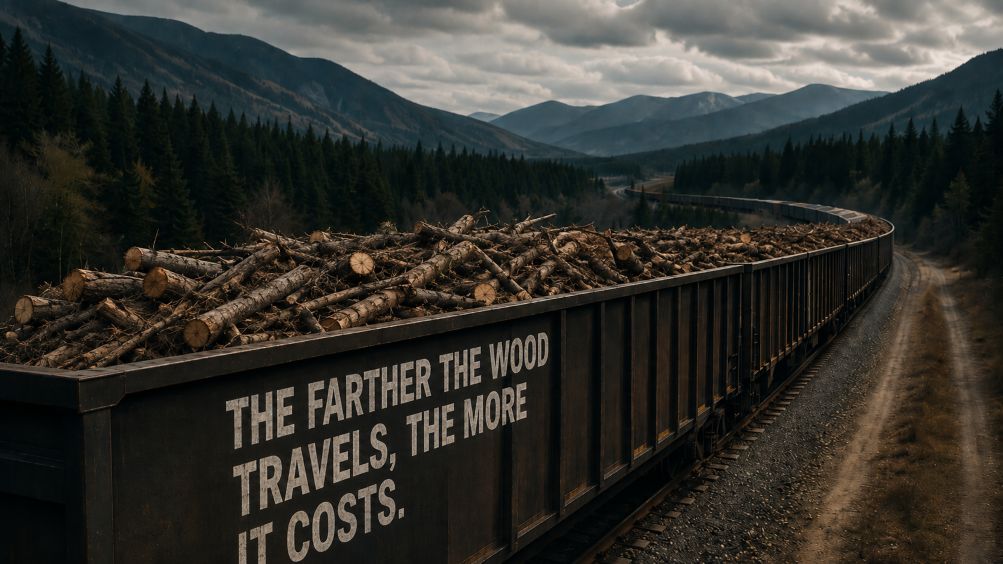
Suppose there are hundreds of thousands of tons of low-value woody biomass in a rural region:
- Distressed pulpwood
- Fuels reduction material
- Precommercial thinnings
- Harvest slash
- Cull and bucked trees
- Other low-value woody material
You want to use that biomass for carbon removal. Where should the facility go?
One option is to build a large centralized plant far away, then move the biomass to it. That can mean trucking material to a depot, unloading it, drying or grinding it, transferring it to rail, moving it long distances, unloading it again and perhaps putting it back on trucks for the final leg.
Every one of those steps adds cost. With green wood, you may even be paying to move a fair amount of water along the way.
Build the Facility Where the Wood Already Is
Carbon Yards takes the opposite approach.
If Spooner, Wisconsin, has abundant low-cost woody biomass, build a Carbon Yard in Spooner. If another large supply basin exists in southern Mississippi, build the next one there.
The supply chain becomes much simpler:
Forest → chipper → truck → Carbon Yard.
That is a fewer steps between the forest and permanent carbon storage.
Carbon Yards Aren’t Picky
Many biomass conversion systems can technically accept a range of feedstocks, but industrial equipment generally performs better when the material is relatively consistent. Moisture, particle size, ash content and composition can all matter, which often means additional drying, grinding, screening or blending.
Carbon Yards doesn’t use reactor feedstock, so feedstock specifications are less of an issue. It only needs simple, suitable wood chips.
Those chips can come from distressed pulpwood, whole-tree material, branches, tops, bark, small-diameter trees and forestry residues. They can be relatively clean or relatively messy.
That broad tolerance allows Carbon Yards to look for places where woody biomass is abundant, inexpensive and poorly served by existing markets.
The sourcing question becomes less about finding material that meets a narrow plant specification and more about finding places with a lot of cheap woody carbon.
Then build there.
Scale the Facility, Not the Supply Chain
Scaling works the same way. Rather than making one plant larger and hauling material from farther away, build another standardized Carbon Yard near the next major supply basin.
You replicate the facility instead of stretching the supply chain.
The result is a simple combination:
Short hauling distances + low feedstock-grade sensitivity + weak competition for wood = lower delivered biomass cost.
There is plenty of sophisticated science behind carbon removal, but some of the economics are straightforward:
Don’t haul cheap, heavy material hundreds of miles if you can build the facility next to it.